Transforming Math Education with AR/VR in Our Ultimate Computer Lab
- Shawntaye Adams
- Nov 18, 2024
- 2 min read


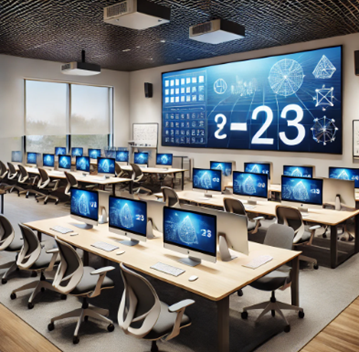
The integration of Augmented Reality (AR) and Virtual Reality (VR) in our ultimate community college math lab represents a significant leap forward in enhancing student learning. Traditional math teaching often struggles to convey complex concepts effectively, especially in subjects like calculus (Salinas et al., 2015). By incorporating cutting-edge technologies like GeoGebra AR, Oculus Rift, and Microsoft HoloLens, we aim to revolutionize math education (Fitria, 2023; Liu et al., 2020). GeoGebra AR will allow students to visualize complex functions in 3D, making abstract concepts more concrete. For instance, in a calculus class, students can explore the volume under a curve by interacting with 3D models, enhancing their spatial reasoning. Oculus Rift headsets will be used for virtual field trips, such as visiting the Eiffel Tower to analyze symmetry and geometric principles, linking real-world structures to math lessons. Additionally, Microsoft HoloLens headsets will create an immersive VR lab for personalized tutoring, where students can collaborate with tutors and solve problems on a shared virtual whiteboard. These technologies cater to diverse learning styles, foster engagement, and provide real-time feedback, addressing key challenges in math education (Iatsyshyn et al., 2020; Kaur et al., 2024). By implementing AR/VR, our math lab will not only boost student outcomes but also prepare learners for future STEM careers, setting a new standard for educational excellence.
References:
Fitria, T. N. (2023). Augmented reality (AR) and virtual reality (VR) technology in education: Media of teaching and learning: A review. International Journal of Computer and Information System (IJCIS), 4(1), 14-25.
Iatsyshyn, A. V., Kovach, V. O., Lyubchak, V. O., Zuban, Y. O., Piven, A. G., Sokolyuk, O. M., Iatsyshyn, A.V., Popov, O.O., Artemchuk, V.O., & Shyshkina, M. P. (2020). Application of augmented reality technologies for education projects preparation.
Kaur, G., Kaur, H., Goyal, S., Kaur, V., & Kaur, P. (2024). Role of AR and VR Technology in Transforming Education Ecology. Augmented Reality and Virtual Reality in Special Education, 33-63. https://doi.org/10.1002/9781394167586.ch2
Liu, R., Wang, L., Lei, J., Wang, Q., & Ren, Y. (2020). Effects of an immersive virtual reality‐based classroom on students’ learning performance in science lessons. British Journal of Educational Technology, 51(6), 2034-2049. https://doi.org/10.1111/bjet.13028
Salinas, P., Quintero, E., Ramirez, P., & Mendivil, E. (2015). Fostering Spatial Visualization through Augmented Reality in Calculus learning. age, 26, 1. https://doi.org/10.18260/p.24129

Comments